
If your company operates in Thailand, filing financial statements with the Department of Business Development (DBD) is not merely an administrative formality — it is a statutory legal requirement. Every
registered entity, including dormant and non-trading companies, is obligated to submit audited financial statements annually. Yet every year, many businesses miss critical deadlines or submit incomplete filings, with consequences that can prove both costly and disruptive.
This article sets out the complete compliance framework: the documents required, the precise deadlines, the filing process, and the penalties that arise from non-compliance. It is intended as a practical reference for directors, financial controllers, and business owners operating within the Thai regulatory environment.
Two Agencies, Two Separate Obligations
A common — and costly — point of confusion is that annual financial compliance in Thailand involves two distinct government agencies, each with its own forms, deadlines, and penalty regime:
| Agency | Obligation | Deadline (Dec 31 year-end) |
|---|---|---|
| Department of Business Development (DBD) Ministry of Commerce | File audited financial statements via DBD e-Filing | Within 1 month after AGM (latest: 31 May) |
| Revenue Department (RD) Ministry of Finance | File Annual Corporate Income Tax return (PND 50); Audited financial statements | Within 150 days after Financial Year-end date (latest 30 May or 7 June for e-filing) |
Both the DBD and Revenue Department filings fall in late May for calendar-year companies. They are entirely separate submissions to different agencies — completing one does not fulfil the other.
Key Deadlines: Fiscal Year Ending 31 December
The annual compliance process is strictly sequential. Each step depends on the completion of the one before it. Starting late at any stage compresses every subsequent window.
| 31 December | Fiscal Year Closes All accounts must be closed and bookkeeping finalised. Supporting documents should be compiled and ready for the auditor. |
| Jan – Mar (target) | Statutory Audit by Licensed CPA Financial statements must be audited by a Certified Public Accountant (CPA) registered with the Federation of Accounting Professions (FAP). This obligation applies to all companies, including dormant entities. Leaving the audit too late is the most common cause of cascading deadline failures. |
| By 30 April HARD DEADLINE | Annual General Meeting (AGM) Under Sections 1171 in conjunction with Section 1197 of the Civil and Commercial Code, the AGM must be held within 4 months of the fiscal year-end — no later than 30 April for December year-end companies. Shareholders must formally approve the audited financial statements. Failure to convene the AGM on time is itself a penalisable offence. |
| By 14 May HARD DEADLINE | File Shareholders List — Form Bor Or Jor 5 (BOJ 5) Private limited companies must file the updated shareholders list with the DBD within 14 days of the AGM date. If the AGM is held on 30 April, the BOJ 5 deadline falls on 14 May. |
| By 30 May HARD DEADLINE | File Annual Corporate Income Tax Return (PND 50) — Revenue Department The annual CIT return must be submitted within 150 days after the fiscal year-end plus 8 days for e-filing (Revenue Code, Section 69). A copy of the audited financial statements must accompany this filing. Late submission incurs a fine of THB 2,000 plus 1.5% per month surcharge on unpaid tax. |
| By 31 May HARD DEADLINE | File Audited Financial Statements with DBD via e-Filing The AGM-approved audited financial statements must be submitted to the DBD within 1 month of the AGM date. If the AGM is held on 30 April, the DBD filing deadline is 31 May. This is a separate obligation from the Revenue Department filing, with its own portal, forms, and penalty schedule. |
Deadline Clarification — A Frequent Source of Confusion
The ‘150-day rule’ (Revenue Department / PND 50) and the ‘1-month after AGM rule’ (DBD) are distinct obligations to different agencies. For calendar-year companies: Revenue Department deadline = 30 May; DBD filing deadline = 31 May (if AGM held on 30 April). Critically, if the AGM is held before 30 April, the DBD deadline advances accordingly — it is calculated from the actual AGM date, not from a fixed calendar point.
Documents Required for DBD Filing
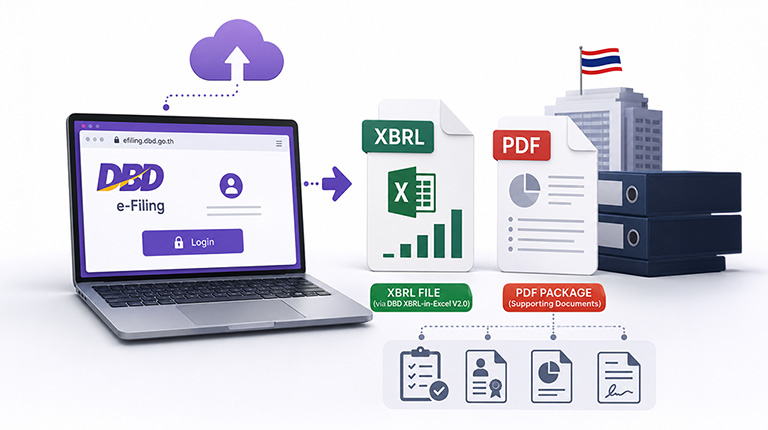
All submissions must be made through the DBD e-Filing portal (efiling.dbd.go.th). Paper filings are no longer accepted. Financial data is submitted in XBRL format, produced using the DBD XBRL-in-Excel V2.0 template, accompanied by a PDF package of supporting documents.
Important Notice: The DBD e-Filing portal operates entirely in the Thai language. Foreign-owned businesses are strongly advised to engage a qualified local professional to manage the submission process and minimise the risk of errors or rejected filings.
| No. | Document | Description |
|---|---|---|
| 1 | Audited Financial Statements | Balance sheet, income statement, statement of changes in equity, and accompanying notes |
| 2 | Auditor’s Report | Signed report from a FAP-registered CPA expressing the audit opinion on the financial statements. |
| 3 | Form Sor Bor Chor 3 | The electronic cover submission form for financial statements, completed through DBD e-Filing. |
| 4 | Date of AGM | The AGM date must be recorded in the submission, as it determines the filing deadline for both the financial statements and the BOJ 5. |
| 5 | Company, Accountant & Auditor Details | Registered company information, details of the accounting officer, and the CPA registration details of the licensed auditor. |
| 6 | Form Bor Or Jor 5 (BOJ 5) | Updated shareholders list — filed as a separate submission within 14 days after the AGM date (private limited companies). |
| 7 | XBRL File + PDF Package | Financial data prepared via DBD XBRL-in-Excel V2.0 (output as .zip), submitted alongside required PDF attachments. |
Document requirements may vary by entity type (private limited company, registered partnership, foreign branch, or joint venture). Public limited companies have additional obligations including annual reports and AGM minutes.
Government Filing Fees
There is no government fee payable for submitting financial statements through DBD e-Filing. The principal costs associated with annual compliance are:
- Professional fees for the statutory audit conducted by a licensed CPA.
- Accounting and advisory fees for preparation of financial statements and management of the submission process.
- Where applicable, late penalty payments made directly to the DBD at the time of filing (see Section 06 below).
Consequences of Missing the Deadline
Thai law imposes a layered and escalating penalty structure. Fines apply independently to both the company and to the managing director(s) in their personal capacity. The legal bases are the Accounting Act B.E. 2543 (2000) and the Civil and Commercial Code.
Penalty 1 — Failure to Hold the AGM Within 4 Months (by 30 April)
| Party | Maximum Fine | Legal Basis |
|---|---|---|
| Company | THB 20,000 | Civil and Commercial Code, Section 1171, 1197 |
| Director(s) — personally | THB 50,000 | Civil and Commercial Code, Section 1171, 1197 |
Penalty 2 — Late Submission of Financial Statements to the DBD
Under Accounting Act B.E. 2543, Section 11, penalties are assessed on a sliding scale. Directors are personally liable for the same fine as the company itself.
| Delay Period | Fine — Company | Fine — Per Director |
|---|---|---|
| Up to 2 months late | THB 2,000 | THB 2,000 |
| 2 to 4 months late | THB 4,000 | THB 4,000 |
| Over 4 months late, or prior year(s) also unfiled | Up to THB 50,000 | Up to THB 50,000 |
| Maximum statutory penalty (Accounting Act B.E. 2543) | THB 50,000 | THB 50,000 |
The maximum combined exposure — company plus one managing director — is up to THB 100,000 per year on the DBD side alone, entirely separate from any Revenue Department penalties.
Penalty 3 — Late PND 50 Filing with the Revenue Department (by 30 May)
| Delay Period | Fine | Surcharge on Unpaid Tax |
|---|---|---|
| 1 to 7 days late | THB 1,000 | 1.5% per month on outstanding tax |
| More than 7 days late | THB 2,000 | 1.5% per month on outstanding tax |
Escalating Consequences for Persistent Non-Compliance
SERIOUS RISK — DEREGISTRATION
If a company fails to file financial statements for 3 consecutive years, the DBD may strike the company from the business register. Once deregistered, the entity loses its legal status and cannot engage in any business transactions. In 2024 alone, the DBD removed over 11,500 entities from the active registry. Reinstatement through the courts is possible within 10 years but is costly and disruptive.
Beyond financial penalties, sustained non-compliance may further result in:
| Consequence | Parties Affected |
|---|---|
| Police summons issued to the managing director(s) for investigation | Directors personally |
| Criminal prosecution if summons is disregarded (case referred to court) | Directors personally |
| Inability to renew work permits and visas for foreign employees | Foreign employees |
| Loss of BOI promotional privileges and certificates | BOI-promoted companies |
| Revenue Department audit or additional tax assessment | Company |
| Deregistration from the DBD register after 3 consecutive years of non-filing | Company and directors |
Key Deadlines at a Glance — 31 December Fiscal Year-End
| Action | Calculated From | Deadline | Filed With |
|---|---|---|---|
| Hold AGM to approve audited accounts | Directors personally | Directors personally | Directors personally |
| File BOJ 5 (shareholders list) | Directors personally | Directors personally | Directors personally |
| File PND 50 (Annual Corporate Income Tax return) | Foreign employees | Directors personally | Directors personally |
| File audited financial statements | Directors personally | Directors personally | BOI-promoted companies |
Practical Planning Note
If the AGM is convened before 30 April — for example on 15 March — the DBD filing deadline advances to 15 April. Most deadline failures originate not from the filing itself, but from delays in completing the audit. Early engagement of the auditor is the single most effective risk mitigation measure.
Common Compliance Errors We Observe
Based on our experience advising both Thai and foreign-owned businesses, the following patterns consistently give rise to missed deadlines and avoidable penalties:
Leaving the Audit Too Late
The audit must be completed before the AGM can be convened. A delayed audit cascades through every subsequent statutory deadline.
Poor Coordination Between Accounting and Legal Timelines
The AGM, BOJ 5, DBD filing, and PND 50 submission are interdependent. Each is contingent on the prior step being completed within its window.
Underestimating Thai Documentation Requirements
The DBD e-Filing portal operates in Thai. Errors in the XBRL submission format, missing fields, or incorrect data routinely result in rejected filings and wasted time.
Treating the Filing as a Routine Administrative Task
DBD compliance is a multi-step, multi-agency legal process with personal liability implications for directors. It warrants appropriate planning and professional oversight.
Why This Matters Beyond Regulatory Compliance
For foreign-owned businesses operating in Thailand, fulfilment of DBD filing obligations yields tangible commercial and operational benefits that extend well beyond the avoidance of penalties:
Credibility with Banks and Investors — Audited financial statements filed on time signal a well-governed, transparent business to lenders, commercial partners, and potential investors.
Protection of Business Operations — Companies in good standing with the DBD avoid the disruption of escalating fines, police correspondence, and the risk of deregistration.
Smooth Renewals — Work permits, business visas, operating licences, and BOI promotional privileges all depend on the company maintaining full compliance with its statutory filing obligations.

Services Provided by AO Accounting & Advisory Limited
Navigating the interdependent deadlines, Thai-language XBRL submission requirements, and dual-agency compliance framework requires both technical expertise and careful coordination. AO Accounting & Advisory Limited provides comprehensive support across the full annual compliance cycle:
- Coordination of the statutory audit with your licensed CPA.
- Preparation and documentation of Annual General Meeting minutes and resolutions.
- Preparation of the XBRL data file and PDF submission package in accordance with DBD specifications.
- Submission of financial statements via DBD e-Filing within the statutory deadline.
- Preparation and submission of the Corporate Income Tax return (PND 50) to the Revenue Department.
- Filing of the shareholders list (BOJ 5) within the prescribed 14-day window.
- Assistance with late submissions, penalty payments, and regulatory correspondence where deadlines have been missed.
“Filing with the DBD may appear routine — but getting it wrong creates real business risk.
Plan early. Align your timelines. Engage professionals who understand the system.”
— AO Accounting & Advisory Limited