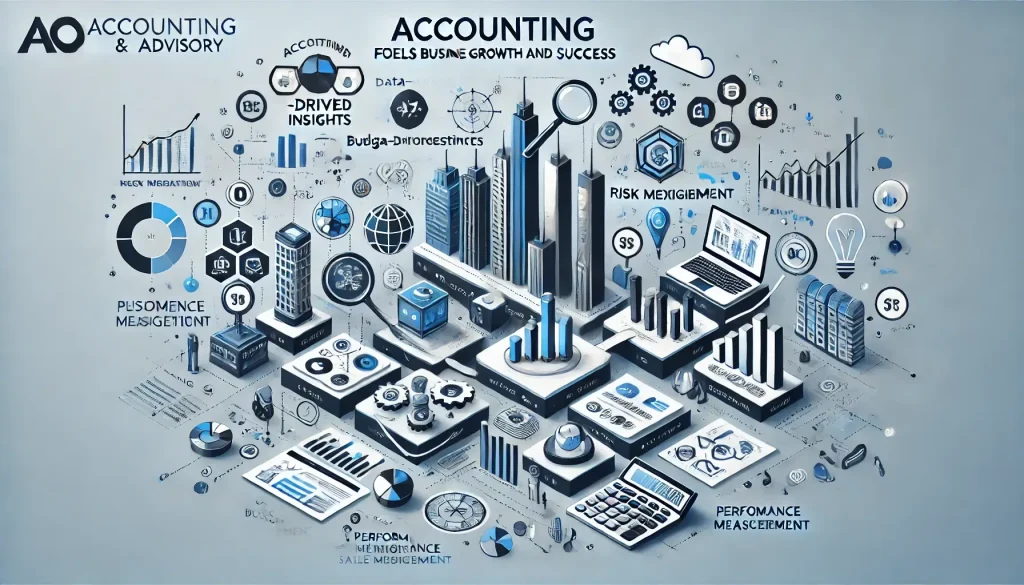
Accounting Fuels Business growth and sccuess. A business growth strategy often conjures images of bold visions, innovative products, and competitive manoeuvres. But behind every successful strategy lies a silent, numbers-driven force: accounting. Far more than just bookkeeping or tax compliance, accounting is the backbone of informed decision-making, risk management, and sustainable growth. Let’s explore how accounting doesn’t just support business strategy—it actively shapes it.
1. Accounting Provides the Data-Driven Foundation Fuel
Every great strategy starts with clarity. Accounting translates raw financial data into actionable insights, answering critical questions like:
– Where is the business making money?
– Which products or services are underperforming?
– What are the cash flow trends, and how do they impact scalability?
For example, a detailed profit-and-loss statement can reveal hidden costs in a seemingly profitable product line, prompting a strategic pivot. Similarly, balance sheet analysis might highlight over-reliance on short-term debt, guiding long-term financing decisions.
Key takeaway To Fuel Accounting
Without accurate financial data, strategy is built on guesswork. Accounting turns intuition into evidence.
2. Bookkeeping Budgeting and Forecasting: The Roadmap to Growth
Strategic planning hinges on anticipating the future. Accounting teams use historical data to create budgets and forecasts that align with business goals. Whether you’re planning to enter a new market, hire staff, or invest in technology, these financial models:
– Identify resource gaps.
– Highlight potential risks (e.g., cash crunches).
– Set measurable milestones for success.
A tech startup, for instance, might use rolling forecasts to adjust R&D spending based on quarterly revenue trends, ensuring agility in a competitive landscape.
3. Cost Management as a Competitive Advantage
Reducing costs isn’t just about trimming expenses—it’s about **spending smarter**. Strategic accounting dives deep into cost structures to:
– Uncover inefficiencies (e.g., redundant software subscriptions).
– Negotiate better terms with suppliers.
– Allocate funds to high-impact areas (e.g., marketing vs. overhead).
Consider a retail business using activity-based costing to pinpoint the true cost of each product line. This insight could drive strategic decisions like discontinuing low-margin items or renegotiating vendor contracts.
4. Risk Mitigation and Compliance
A single compliance misstep or financial oversight can derail even the most brilliant strategy. Accounting safeguards the business by:
– Ensuring adherence to tax laws and regulations.
– Implementing internal controls to prevent fraud.
– Conducting stress tests for scenarios like economic downturns or supply chain disruptions.
For example, a manufacturing firm might use accounting data to assess the financial impact of a potential tariff increase, allowing leadership to diversify suppliers proactively.
5. Performance Measurement: Tracking What Matters
How do you know if your strategy is working? Accounting provides the metrics to measure success, such as:
– KPIs: Gross profit margin, customer acquisition cost, ROI.
– Variance analysis: Comparing actual results to budgets.
– Break-even analysis: Determining the viability of new initiatives.
A SaaS company, for instance, might track monthly recurring revenue (MRR) and churn rates to evaluate the effectiveness of its customer retention strategy.
6. Enabling Long-Term Value Creation
True strategic accounting looks beyond quarterly earnings. It focuses on sustainable value creation by:
– Evaluating investments in ESG (Environmental, Social, Governance) initiatives.
– Assessing mergers and acquisitions for synergy potential.
– Aligning capital allocation with long-term vision (e.g., R&D, employee training).
A family-owned business, for example, might use generational accounting to plan succession and wealth transfer, ensuring legacy continuity.
7. The Role of Outsourced Accounting Firms
For many businesses, building an in-house team with strategic expertise is a challenge. This is where outsourced accounting firms shine. They bring:
– Specialized knowledge: Industry-specific insights (e.g., healthcare, nonprofits).
– Technology: Advanced tools for real-time reporting and predictive analytics.
– Objectivity: An unbiased perspective to identify blind spots.
By partnering with experts, businesses can focus on execution while their accounting partner handles the numbers—turning financial data into a strategic asset.
Conclusion: Accounting Fuels Business Growth
Accounting isn’t just about balancing the books—it’s about balancing ambition with reality. In today’s data-driven world, businesses that integrate accounting into their strategic planning gain a decisive edge. They move faster, mitigate risks, and allocate resources with precision.
Whether you’re a startup scaling rapidly or an established firm navigating disruption, remember: Your financial data isn’t just a reflection of where you’ve been—it’s a roadmap to where you’re going.
Ready to turn your numbers into strategy? Partner with AO Accounting & Advisory to unlock the full potential of your business.
About Accounting and Advisory Ltd, Helping you Automate Accounting
AO Accounting & Advisory Ltd. is a trusted partner for businesses looking to turn financial data into actionable strategy. With a deep understanding of how accounting influences decision-making, risk management, and sustainable growth, AO helps companies make informed, data-driven decisions. From budgeting and forecasting to cost management and risk mitigation, AO’s expert team ensures that businesses can focus on long-term value creation while optimizing financial performance.

By offering specialized, outsourced accounting services, AO provides tailored solutions that help businesses navigate complexity and achieve success—whether managing fuel expenses or scaling for future growth. With AO, businesses gain more than just compliance—they gain a strategic ally in their pursuit of excellence.
FAQs on Actionable Accountancy
How can accounting help businesses make more informed strategic decisions?
Accounting provides businesses with accurate financial data, allowing them to identify trends, uncover inefficiencies, and allocate resources more effectively. This data-driven foundation enables leaders to make well-informed decisions that align with their business goals.
What role does accounting play in risk management and compliance?
Accounting helps businesses identify potential risks—such as cash flow issues or regulatory changes—and ensures compliance with tax laws and industry regulations. It also provides internal controls to prevent fraud and conducts stress tests to safeguard against financial disruptions.
How does forecasting and budgeting influence business strategy?
By using historical financial data, accounting teams create budgets and forecasts that align with a company’s strategic goals. This allows businesses to anticipate resource needs, identify potential risks, and set measurable milestones for success, ensuring the business is well-prepared for future growth.
Why is cost management crucial for gaining a competitive advantage?
Accounting helps businesses identify inefficiencies, manage overhead, and allocate resources to areas with the highest return on investment. Smarter spending through detailed cost analysis can lead to better supplier negotiations, improved margins, and enhanced profitability.
How can outsourced accounting firms contribute to business strategy?
Outsourced accounting firms bring specialized knowledge, advanced technology, and an objective perspective to the table. By handling complex financial tasks, they free up businesses to focus on strategic initiatives while ensuring that their financial operations are efficient, compliant, and aligned with long-term goals.