Which Industries Qualify and What Incentives They Receive — Updated for 2026
Published by AO Accounting & Advisory Ltd. | March 2026 | Bangkok, Thailand
If you are considering investing in Thailand or expanding an existing operation, understanding the Thailand Board of Investment (BOI) promotion scheme is essential. BOI promotion can unlock significant advantages — from corporate income tax (CIT) exemptions lasting up to 13 years to 100% foreign ownership rights — but only for businesses operating in eligible activities under the BOI’s defined categories.
This guide breaks down the key Thailand BOI eligible activities under the 2025 promotion scheme, the incentive tiers available, and the important 2026 updates every investor should know about. Whether you are in manufacturing, technology, clean energy, or services, this article will help you determine whether your business qualifies.
What Is the Thailand BOI Promotion Scheme?
The Board of Investment of Thailand (BOI) is a government agency that promotes both domestic and foreign investment through a tiered incentive framework. Operating under the Investment Promotion Act of 1977 and its subsequent amendments, the BOI provides tax and non-tax incentives to businesses that invest in activities aligned with Thailand’s national economic development priorities.
The 2025 BOI promotion scheme continues to build on Thailand’s “Thailand 4.0” strategy, which aims to shift the economy toward high-value-added, technology-driven, and sustainable industries. The scheme is structured around a merit-based activity classification system, where the level of incentives a project receives depends on its category — ranging from A1+ (highest incentives) to B (non-tax incentives only).
The BOI Activity Category Framework: A1+ to B
Under the 2025 BOI promotion scheme, all eligible activities are classified into five categories based on their technological value, innovation intensity, and economic contribution. Understanding this framework is the first step to assessing your project’s potential benefits.
Category | CIT Exemption | Description |
A1+ | Up to 13 years (no cap) | Highest innovation & R&D intensity; activities critical to national competitiveness |
A1 | 8 years (no cap) | High-tech manufacturing, advanced digital services, frontier industries |
A2 | 8 years (capped at 100% of investment) | Technology-intensive activities with significant value-added |
A3 | 5 years (capped at 100% of investment) | Capital or technology-intensive manufacturing and services |
A4 | 3 years (capped at 100% of investment) | Activities supporting industrial development |
B | No CIT exemption | Non-tax incentives only (e.g., import duty exemptions, land ownership rights) |
All categories except B are also eligible for import duty exemptions on machinery and on raw materials used in production for export. Non-tax incentives — including the right to own land, bring in foreign experts and skilled workers, and operate with 100% foreign ownership — are available across all promoted categories.
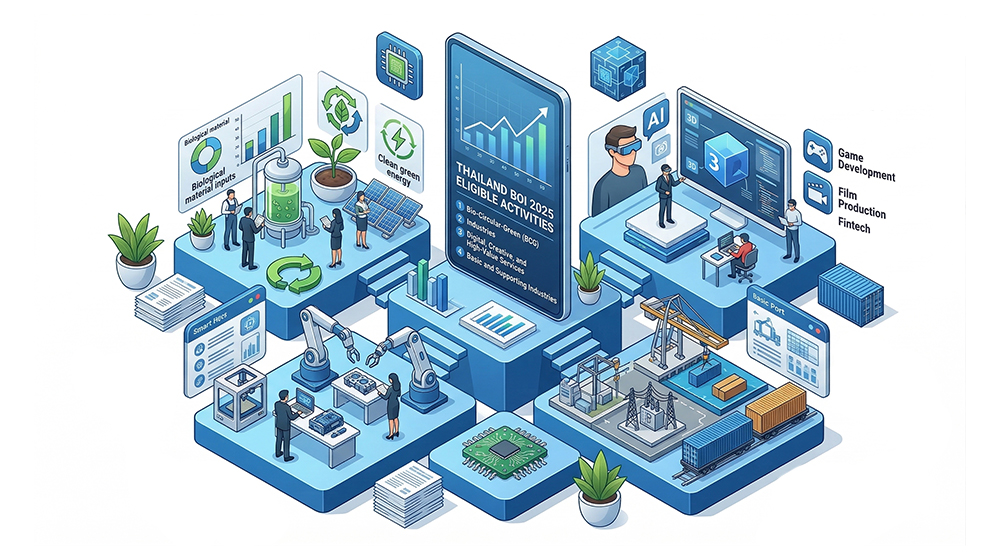
Key Thailand BOI Eligible Activities Under the 2025 Scheme
The BOI organises eligible activities into four broad industry groupings. Below is a detailed overview of which sectors qualify and what they can expect to receive.
1. Bio-Circular-Green (BCG) Industries
The BCG economy model — encompassing biological, circular, and green industries — is a pillar of Thailand’s long-term growth strategy. BOI-eligible activities in this grouping include:
- Advanced agriculture and agricultural biotechnology (A1–A2)
- Bio-based materials and biofuels production (A1–A2)
- Medical devices, pharmaceuticals, and health products (A1–A2)
- Precision and smart farming using IoT and data analytics (A1)
- Environmental and waste management services (A3–A4)
Projects in high-priority BCG activities can qualify for A1 or A1+ status, receiving up to 8 years of CIT exemption without a cap. Advanced biotechnology and R&D-intensive bio-based projects may qualify for extended 13-year exemptions under the A1+ category.
2. Advanced Manufacturing Industries
Advanced manufacturing remains a core focus of the BOI’s promotion efforts, particularly as Thailand seeks to position itself as a regional production hub.
- Electric vehicle (EV) and EV component manufacturing (A1–A2)
- Next-generation automotive parts and systems (A1–A2)
- Smart electronics and advanced semiconductors (A1–A2)
- Aerospace and advanced materials (A1)
- Industrial automation and robotics manufacturing (A1–A2)
- Medical equipment and precision instruments (A1–A2)
It is important to note that following the May 2025 BOI policy updates, the promotion of certain manufacturing activities was suspended. These include the manufacturing of solar cells and panels, lead-acid batteries, non-essential vehicle accessories, coil centers, long steel products, and hot-rolled steel products — activities identified as either vulnerable to U.S. trade measures or prone to market oversupply.
Additionally, tighter scrutiny of “essential production processes” has been applied to sectors at risk from U.S. trade measures, including automotive parts, electrical appliances, electronics, and metal products. Core manufacturing must genuinely occur in Thailand, with at least a 4-digit customs tariff code change demonstrating meaningful transformation.
3. Digital, Creative, and High-Value Services
Thailand’s BOI has significantly expanded its support for digital-sector businesses, reflecting the country’s ambitions to become Southeast Asia’s digital hub.
- Data centres, cloud services, and data hosting (A1–A2, revised May 2025)
- Software development, digital platforms, and SaaS products (A1–A2)
- AI development, machine learning, and deep tech (A1)
- Electronic design and embedded systems (A1–A2)
- Digital content and creative media production (A2–A3)
- International headquarters (IHQ), treasury centres, and trading companies (A3–B)
- Research and development centres (A1+–A1)
Following the May 2025 revision, data centre applicants must now demonstrate advanced computing technology, efficient electricity and water usage, and submit a workforce development plan — which can include collaboration with Thai universities, R&D commitments, or use of locally manufactured equipment.
4. Basic and Supporting Industries
The BOI also promotes investment in industries that strengthen Thailand’s industrial base and infrastructure:
- Industrial estates and industrial zones (A3–A4)
- Logistics and supply chain infrastructure (A3–B)
- Utilities includin g clean energy and waste-to-energy projects (A1–A3)
- Educational and vocational training institutions (A4–B)
- Tourism-related infrastructure in second-tier provinces (B, enhanced incentives from May 2025)
In May 2025, the BOI introduced enhanced incentives for tourism businesses operating in 55 second-tier provinces. This measure reflects the government’s policy of distributing tourism’s economic benefits more broadly across the country.
BOI Incentives: Tax and Non-Tax Benefits in Detail
Tax Incentives
The core tax benefit of BOI promotion is the CIT exemption. Depending on the activity category and project location, promoted companies can receive:
- CIT exemption for 3 to 13 years (with potential extension under the Competitiveness Enhancement Act)
- An additional 1-year CIT exemption for projects located within promoted industrial estates or industrial zones
- An additional 3 years of CIT exemption for projects located in one of the 20 designated low-income areas
- A 50% CIT reduction for up to 3 years following the end of the tax holiday period
- Exemption from import duties on machinery for all promoted categories
- Exemption from import duties on raw materials used in production for export
- Exemption from import duties on materials used for R&D
Non-Tax Incentives
Regardless of activity category, all BOI-promoted companies are eligible for a range of non-tax benefits that are otherwise unavailable under Thailand’s Foreign Business Act:
- Permission to own land for use in the promoted project
- 100% foreign ownership (for most activities not listed under the Foreign Business Act’s restricted lists)
- Facilitated visas and work permits for foreign experts, skilled workers, and their families
- Permission to bring foreign currency into and out of Thailand

2026 BOI Updates: What Has Changed?
The BOI landscape has continued to evolve significantly into 2026, and investors must be aware of the following key developments.
January 2026: Refreshed Promotion Measures for 2026–2027
On 15 January 2026, the BOI announced a refreshed package of investment promotion measures to replace programs that expired in 2025. The new measures are open for applications from the first working day of 2026 through the last working day of 2027 (with some expiring earlier). The updated framework covers advanced manufacturing, automation, EVs, mobility technologies, and high-value R&D, offering stronger tax incentives and broader eligibility than the previous cycle.
Thailand FastPass: Accelerated Approvals for Large-Scale Investors
The BOI launched the Thailand FastPass scheme to accelerate the process for qualifying large-scale investors — specifically, projects with a minimum investment of 1 billion THB in high-tech priority sectors such as EVs, digital infrastructure, and biotechnology. FastPass projects benefit from streamlined regulatory approvals across seven key government agencies, and selected projects must invest at least 20% of their committed value within six months of receiving the FastPass card.
New AI and Automation Subcategories
The government introduced new subcategories within the digital and technology sector — including quantum computing, advanced robotics, and generative AI — broadening the scope of activities eligible for BOI promotion. Early applicants benefit from a first-mover advantage and access to standard 8-year CIT exemptions across this wider range of AI-related activities.
Enhanced SME Support
For Thai SMEs, the 2025 BOI update significantly increased the benefits available. Eligible SMEs that upgrade their capabilities — through new machinery, automation, digital technology adoption, energy efficiency improvements, or compliance with international sustainability standards — can now receive a 5-year CIT exemption capped at 100% of the productivity-enhancement investment, up from the previous 3-year exemption capped at 50%.
Sustainability and BCG Criteria from March 2026
From March 2026, the BOI introduced stricter sustainability criteria aligned with Thailand’s BCG economy strategy and its 2050 carbon neutrality target. Promoted projects are now expected to demonstrate measurable carbon reduction targets, renewable energy usage, and circular economy principles as part of their application.
OECD Global Minimum Tax and the New QRTC
A landmark development for multinational investors concerns the OECD Global Minimum Tax (GMT) framework. Thailand’s Finance Ministry has confirmed that tax privileges for companies subject to the GMT’s 15% minimum tax rate will be restructured. The BOI and Finance Ministry are developing a Qualified Refundable Tax Credit (QRTC) as an alternative instrument. Under the QRTC, qualifying expenditures on R&D, high-skill workforce development, and efficiency improvements would be treated as refundable tax credits. Existing incentives remain available while the QRTC framework is finalised, and further details are expected to be announced following completion of the consultation process.

Minimum Requirements for BOI Promotion
All projects applying for BOI promotion must meet the following baseline criteria regardless of activity category:
- Minimum capital investment of 1 million THB per project (excluding land and working capital)
- Value-added of at least 20% of revenue (or 10% for agriculture, electronics, and coil centre activities)
- Use of modern production processes approved by the Board
- Use of new machinery (special criteria apply for imported used machinery)
- Adequate environmental protection measures; projects requiring an EIA must comply with environmental law
For expansion projects, a minimum investment of 500 million THB is required to qualify for additional CIT incentives beyond standard criteria.
Eastern Economic Corridor (EEC): Enhanced Incentives for Target Industries
Investors in Thailand’s Eastern Economic Corridor (EEC) — covering Chonburi, Rayong, and Chachoengsao provinces — can access incentives beyond the standard BOI framework. For A1+ to A4 activities located in EEC special zones (such as EECi, EECd, EECmd, EECg, and EECtp), the following apply:
- CIT exemptions of up to 15 years in combination with the Competitiveness Enhancement Act
- An additional 50% CIT reduction for 2–3 years after the main tax holiday
- Facilitated EEC Work Permits for top management, skilled specialists, and their families
- A reduced personal income tax rate of 17% for qualified professionals
- Land ownership rights for promoted activities
The EEC attracted 33% of all foreign capital entering Thailand between January and November 2025, underscoring its continued importance as a destination for advanced manufacturing, digital infrastructure, and life sciences investment.
How AO Accounting & Advisory Can Help
Navigating the Thailand BOI promotion framework requires careful activity classification, project structuring, and documentation — and the stakes are high. Submitting an incomplete or poorly positioned application can result in delays, reduced incentive tiers, or outright rejection.
At AO Accounting & Advisory, our team of experienced Thailand investment advisors can assist you with:
- Assessing whether your business activity qualifies under the current BOI eligible activities list
- Determining the optimal incentive category and structuring your project to maximise benefits
- Preparing and submitting your BOI application, including all required supporting documentation
- Advising on location planning to take advantage of industrial estate and EEC incentives
- Ongoing compliance support post-promotion, including condition monitoring and incentive utilisation
- Guidance on the evolving QRTC framework and its implications for your investment structure
Whether you are a foreign investor entering Thailand for the first time, a Thai SME looking to upgrade and access enhanced incentives, or a multinational group navigating the intersection of BOI promotion and the OECD Global Minimum Tax, we provide the expert guidance you need.