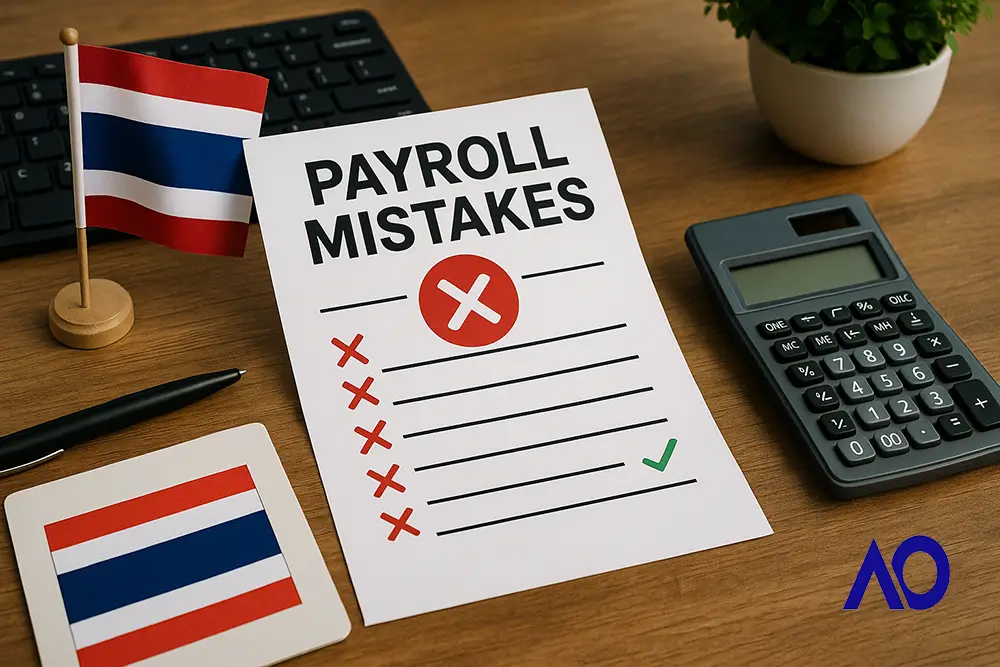
(And How to Protect Your Business from Costly Penalties)
Payroll might seem like a simple numbers game, but one small error can lead to serious legal, financial, and employee trust issues. In Thailand, where tax laws, labor protections, and government contributions are complex and constantly evolving, many companies unknowingly make mistakes that cost them time and money.
The good news? Outsourcing payroll services can help you avoid these common pitfalls. Here’s a closer look at businesses’ top payroll mistakes and how outsourcing helps you stay compliant and stress-free.
🚨 1. Miscalculating Salaries, Overtime, or Deductions
Incorrect salary calculations are the most common payroll error. This includes:
- Underpaying overtime or holiday wages
- Failing to deduct personal income tax (PIT) correctly
- Miscalculating Social Security Fund (SSF) contributions
- Not including bonuses or allowances in taxable income
How Outsourcing Helps:
Payroll providers use automated systems that apply the latest laws and calculations accurately, so your employees always get paid correctly and your tax filings are error-free.
⏱️ 2. Missing Tax or Fund Filing Deadlines
In Thailand, employers must submit:
- PIT (PND.1) filings monthly
- Social Security contributions monthly
- Annual returns like PND.1 Kor and Form 50 bis
- Provident Fund reports (if applicable)
Missing these deadlines can result in fines and legal scrutiny.
How Outsourcing Helps:
Your payroll provider monitors all deadlines, prepares the necessary forms, and files them on time—automatically.
📉 3. Using Outdated Tax Rates or Labor Regulations
Thailand’s minimum wage, tax brackets, and SSF rules change regularly. If you’re using old formulas or templates, you risk under- or over-deducting amounts.
How Outsourcing Helps:
Professional providers are always updated on regulatory changes, so your payroll reflects the latest law every month, not every year.
🧾 4. Failing to Provide Accurate Payslips or Employment Records
By law, employees in Thailand must receive a detailed payslip showing salary, deductions, and hours worked. Failing to provide this documentation may cause disputes or labor office investigations.
How Outsourcing Helps:
Outsourced providers generate legal, standardized payslips and maintain accurate employee records—helping you avoid audits or employee complaints.
👥 5. Misclassifying Workers (Employee vs. Freelancer)
If you misclassify a full-time employee as a freelancer to avoid taxes or benefits, you risk heavy penalties under Thai labor law.
How Outsourcing Helps:
Experts will help you properly categorize workers, apply the right tax treatments, and maintain legal employment contracts.
📅 6. Overlooking the Upcoming Employee Welfare Fund (Effective Oct 2025)
Starting October 1, 2025, companies with 10+ employees must contribute to Thailand’s Employee Welfare Fund, designed to support workers in case of job loss or disability.
How Outsourcing Helps:
Top providers like AO Accounting & Advisory are already preparing clients for this transition. We’ll update your payroll to include the new deductions and ensure timely compliance.
🔐 7. Security Risks from Internal Payroll Management
Storing sensitive salary and tax data in spreadsheets or outdated systems creates a data breach risk. Internal staff may also have conflicts of interest.
How Outsourcing Helps:
Payroll outsourcing providers offer secure, encrypted platforms to handle employee data, with strict confidentiality protocols in place.
📊 8. No Backup or Audit Trail
If your finance or HR manager leaves suddenly, or if you face a surprise audit, do you have accessible payroll history, tax records, and submission receipts?
How Outsourcing Helps:
Your provider maintains a full audit trail of all filings and records, accessible anytime, with professional support to respond to audits or inspections.
🤝 Why AO Accounting & Advisory?
At AO Accounting & Advisory, we offer more than just accurate payroll. We give you peace of mind. Our bilingual team helps both Thai and international businesses:
- Stay 100% compliant with all Thai labor and tax laws
- Prepare for future changes like the Welfare Fund
- Generate legal payslips and documentation
- File on time, every time
- Avoid costly errors and save internal time
📌 Summary: Mistakes You Can Avoid with Payroll Outsourcing
| Common Payroll Mistakes | How Outsourcing Solves It |
| Incorrect salary/tax/overtime calculations | Automated, accurate systems based on Thai law |
| Late or missed filings | Deadline tracking and auto-submission |
| Using outdated tax rates or rules | Regular legal updates are applied in real time |
| Missing payslips or records | Professional payslip generation and recordkeeping |
| Worker misclassification | Legal HR categorization and proper deductions |
| Ignoring new regulations like the Welfare Fund | Early prep and seamless updates |
| Poor data security or backups | Encrypted, professional payroll platforms |
FAQs About Payroll Outsourcing
Q: What are the most common payroll mistakes that businesses make?
A: Some common payroll mistakes include misclassifying employees, calculation errors, and missing payroll deadlines. These errors can lead to discrepancies in payroll reports and can significantly impact payroll compliance.
Q: How can outsourcing payroll help reduce payroll errors?
A: Outsourcing payroll allows businesses to leverage the expertise of payroll professionals who are well-versed in payroll processes and compliance. This can help avoid payroll mistakes, such as misclassifying employees and ensuring accurate tax withholding.
Q: What should I do if I discover a payroll discrepancy?
A: If you find a payroll discrepancy, it is crucial to take immediate action by reviewing the payroll records and working with your payroll team to correct errors. This may involve adjusting paychecks and ensuring compliance with payroll policies.
Q: How can I avoid payroll mistakes when managing payroll?
A: To avoid payroll mistakes, implement an automated payroll system that includes time tracking, regular audits of payroll reports, and employee training on payroll processes to minimize data entry errors.
Q: What are the consequences of payroll mistakes for an employer?
A: The consequences of payroll mistakes can include financial penalties, increased scrutiny from tax authorities, and potential legal issues. It can also lead to employee dissatisfaction if they are underpaid or overpaid.
Q: Why is correct classification of employees important in payroll?
A: Correctly classifying employees is important to avoid misclassification issues that can lead to incorrect tax withholding and payroll compliance problems. Misclassifying employees can result in significant financial liabilities for employers.
Q: How can payroll services improve payroll accuracy?
A: Payroll services can improve payroll accuracy by utilizing advanced payroll software that minimizes manual data entry and automates calculations, thereby reducing the likelihood of common payroll errors.
Q: What should I include in my payroll calendar to avoid missing payroll deadlines?
A: Your payroll calendar should include key dates such as payroll processing deadlines, tax payment due dates, and employee time tracking periods. Keeping this information organized helps ensure that you meet all payroll deadlines consistently.
Q: How can I ensure accurate tax withholding for my employees?
A: To ensure accurate tax withholding, regularly review employee payroll information, stay updated on tax laws, and consult with payroll professionals to adjust withholdings as necessary based on employee classifications and rates.
Q: What role does time tracking play in preventing payroll mistakes?
A: Time tracking is essential in preventing payroll mistakes as it ensures that employee hours are accurately recorded, which directly impacts calculations for paychecks and helps avoid underpayment or overpayment errors.